

Even after the transition periods for the certification of power generating plants under the German grid code VDE (Committee of German engineers) connection guidelines have expired, many questions remain regarding the correct installation of the required fault recording systems. A. Eberle fully complies with VDE-AR-N 4110 & 4120 – including Annex F. In this annex, we set benchmarks as one of the few suppliers fulfilling all key requirements such as IEC 61000-4-30 (Class A, Ed. 3), sampling rates up to 20 kHz, corresponding calibration (DAkkS, etc.), and seamless data transfer.
Annex F defines the requirements for fault recording systems, including:
- Mandatory event and fault recorders for grid stability and disturbance analysis
- Voltage quality measurement according to IEC 61000-4-30 (Class A)
- High sampling rates for detecting transients and supraharmonics
- Time and event synchronization (e.g. via GPS)
- Standardized and seamless data provision for grid operators
- Traceable calibration according to national standards (e.g. DAkkS)
Your benefit: Our guideline and solutions help you identify critical requirements at an early stage, select the right components, and avoid delays or additional costs during certification – ensuring compliance and long-term reliability.
Do you have questions or upcoming projects regarding the implementation of VDE-AR-N 4110 & 4120 (including Annex F)? Then feel free to contact us directly via our contact page.
VDE-AR-N 4110 & 4120 including Appendix F – Testing With High-Precision Measurement Technology Is Necessary.
Planning errors in the construction of large-scale generation units often lead to increased costs and delayed certification. Admittedly, this is also due to a very complex issue. According to chapter 6.4 of VDE-AR-N 4110, fault recording and power quality monitoring are recommended for transfer stations in justified cases. For systems in the individual verification procedure, the requirement is formulated in more detail. In that case, a recorder must be installed to “be able to continuously check the requirements for dynamic mains support in live operation, if compliance with the requirements for dynamic mains support could not already be demonstrated by measurements during commissioning” [standardised extract from VDE-AR-N 4110]. This measurement test must, of course, be carried out using suitable, high-precision measurement technology, tested in accordance with the standard.
The individual verification procedure required for some systems with the installation of a fault recorder for compliance monitoring, to be carried out by an accredited certification body, requires a high degree of coordination between all actors involved. First of all, the appropriate measurement technology, which meets all requirements, must be selected for the verification procedure. In addition, the necessary expertise is required for the correct installation of the measurement technology. Furthermore, certain requirements for the transducers used must be taken into account, as well as the necessary verification to ensure the required accuracies (DAKKS calibrations) of the technologies used. With regard to the subsequent compliance check, an easy-to-implement half-yearly data exchange must be ensured.
This guide provides a practical overview of the most important components to ensure and facilitate a reliable measurement chain.

Requirements for Fault Recorders
According to Annex F of the connecting guideline, the fault recorder requires certification according to class A of IEC 61000-4-30 (Ed. 3) to ensure safety and accuracy of measurement. Annex F requires the sampling frequency of the recorders to be at least 1 kHz. However, for the evaluation of voltage and current supraharmonics in the frequency band range of 2-9 kHz, which is subdivided into 200 Hz bands according to DIN EN 61000-4-7, it is essential to provide higher sampling frequencies for the measurement. Therefore, a minimum sampling frequency of 20 kHz is required to be able to perform the required measurement according to FGW TR 3.
In order to ensure consistent data recording even in case of failure and power failure and to document the reaction of EZA even in case of power failure, a UPS system for the measuring device and additional components such as the communication infrastructure (switches, gateways, servers) is recommended in any case. Of course, there must be no loss of parameters and data in the power quality measuring device used, even in a de-energised state. This must be ensured by the measuring device and the configuration. Reliable data is required especially in the event of a fault.
In this context, time synchronisation plays an important role. Therefore, an external synchronisation, e.g. via GPS, is necessary to ensure a maximum accuracy in the overall system of up to 25 µs. The accuracy of the entire measurement chain is of great importance in the detection process.
However, the accuracy of the measurement result does not only consist of a high-precision measuring device with a maximum deviation of 0.1% and the corresponding verification, but the total error of the entire measurement chain is significantly influenced by the transducers used.
Thus, for example, the transformers used must also be capable of transmitting supra-harmonics without error. In the medium and high voltage range, there is already a wide variety of transformers on the market that can also transmit frequencies in the 2-9 kHz range with deviations <0.1%. Especially in DCA systems with DC link controlled power supply, dominant clock frequencies are often responsible for feedback effects such as increased noise generation, as can be seen in figure 2.
This requires that the fault recorder supports a wide variety of transducer technologies with respect to the input signals.For example, transducers that can pick up the higher frequency range of 2-9 kHz are usually equipped with 3.25 V/√3 outputs instead of 100 V/√3.In any case, the impedance ratio between the transducer output and the encoder input must match. Therefore, it is necessary to check the respective impedance requirements prior to acquisition and to clarify in advance the necessary data for the measuring instrument and the selected measuring input with the supplier of the transducer to be used.

Measuring With Sensors Simple and Highly Accurate
The PQI-DE supports a wide range of combinations and installation situations, both in the area of voltage measurement and through the various current measurement possibilities, also in the area of retrofitting, e.g. through the high-precision Rogowski inputs for current measurement.
- 100 V 2 MOhm || 25 pF
- 100 V / 400 V / 690 V 10 MOhm || 25 pF
- 3.25 V 2 MOhm || 50 pF for small-signal transducers according to IEC 61869-11 (SELV)
- 4 current inputs for transducers 1 A/5 A (MB max. 10 A)
- 4 current inputs for protection transformers 1 A/5 A (MB max. 100 A)
- 4 current inputs for Rogowski clamps (Input 350 mV)
- 4 current inputs for current clamp meter (AC converter 0.5 V input)
DAKKS Calibration Required
To ensure and guarantee the accuracies, a DAKKS calibration is required before delivery and installation of the measuring device. The standard factory calibration is not sufficient for certification.
For this reason, A. Eberle GmbH & Co. KG requires an extended DAKKS calibration by a certified laboratory, also in the field of supra-harmonics for the measuring devices.
Click here for an example of such certificate.
According to the connection guideline, the certification body has the task to evaluate the measurement data at least every six months. For this purpose, a simple and seamless data exchange must be ensured. In addition, the system must be able to provide a suitable software solution to evaluate the data. It is important to use a system with simple, flexible and open interfaces, which can be adapted to on-site conditions and communication solutions.

System Requirements
Simple
In the simplest case, the data transfer from the measuring device to the certification body must be done by inserting an SD card and copying the entire internal memory. The readout in a power quality evaluation software works similarly in a plug & play procedure.
Flexible
From simple data transfer by inserting an SD card to automated data transfer via mobile radio, SHDSL or Ethernet: always trouble-free, even with poor connection quality. Diverse and customisable system solutions should be possible.
Open
Comtrade or PQDIF as standard via IEC 61850, IEC 60870-5-104 or Modbus. The measuring instruments and the WebPQ® system of A. Eberle GmbH & Co. KG have numerous open standard interfaces and protocols for the transmission of measurement data.
WebPQ®: Automatic Compliance Check of Power Plants Using FRT Curves
Power plants connected to public grids must ensure dynamic grid support in accordance with the European Grid Code (RFG – EU 2016/631) as well as with national and regional grid codes worldwide. This requirement applies especially during fault situations and defines how generating plants must behave under symmetrical and asymmetrical grid faults.
Key requirements include:
- No disconnection of the generating plant during undervoltage or overvoltage events within the limits specified by the applicable FRT curve.
- Dynamic support also during multiple consecutive faults, without automatic shutdown.
- Injection of reactive current (reactive power) to support the grid voltage during and immediately after the disturbance. The reactive current must be provided in both positive and negative sequence systems depending on the type of fault.
What are FRT Curves?
FRT (Fault Ride Through) curves define the voltage-time profile that a power generating unit (PGU) must withstand without disconnecting from the grid. In other words, they specify how long a plant must “ride through” a fault at certain voltage levels.
- European perspective: In the EU, FRT requirements are harmonized under the Requirements for Generators (RfG). These are further detailed in national implementations (e.g., Germany: VDE-AR-N 4110/4120, UK: G99, Spain: P.O. 12.3).
- International perspective: Similar requirements exist worldwide, often adapted to local grid structures and stability needs. For example:
- North America: NERC PRC standards and FERC-approved reliability guidelines.
- Latin America: Brazil (ONS Grid Code), Chile (NTCO).
- Asia-Pacific: China (GB/T standards), India (CEA regulations), Australia (AEMO Grid Code).
- Middle East & Africa: Grid codes often follow the European model, with country-specific adaptations.
In all cases, the basic principle remains the same: plants must stay connected and support the grid during short disturbances instead of disconnecting, which could otherwise destabilize the power system.
Verification with WebPQ®
To ensure compliance with these requirements across diverse installations, the WebPQ® Power Quality System software (from version V.2.1) includes an add-on for the automatic classification of disturbances based on FRT curves already integrated in the system.
- Each measurement point can be assigned a corresponding FRT curve according to plant type and applicable grid code.
- Disturbances over longer periods (e.g., one year) can be automatically evaluated and classified (Figure 3).
- WebPQ® comes with default FRT curves for plant type 1 and plant type 3, covering the most relevant cases but can be also adapted for every VRT – Voltage Ride Through curve or Fault Ride through curve – with the FRT Template Editor
Technical Requirements
It should be noted that FRT curves typically provide for fault evaluations of up to 60 seconds. Therefore, the fault recorder used must supply 10 ms rms values, even during multiple consecutive faults, as explicitly required by most grid codes.
For comparability and normative accuracy, it is strongly recommended to calculate the rms values in accordance with IEC 61000-4-30 – Class A, Edition 3. This ensures that the evaluations are uniform and compliant with international standards.

WebPQ®
The Easy Way to Analyse Your Power Quality Measurement Data
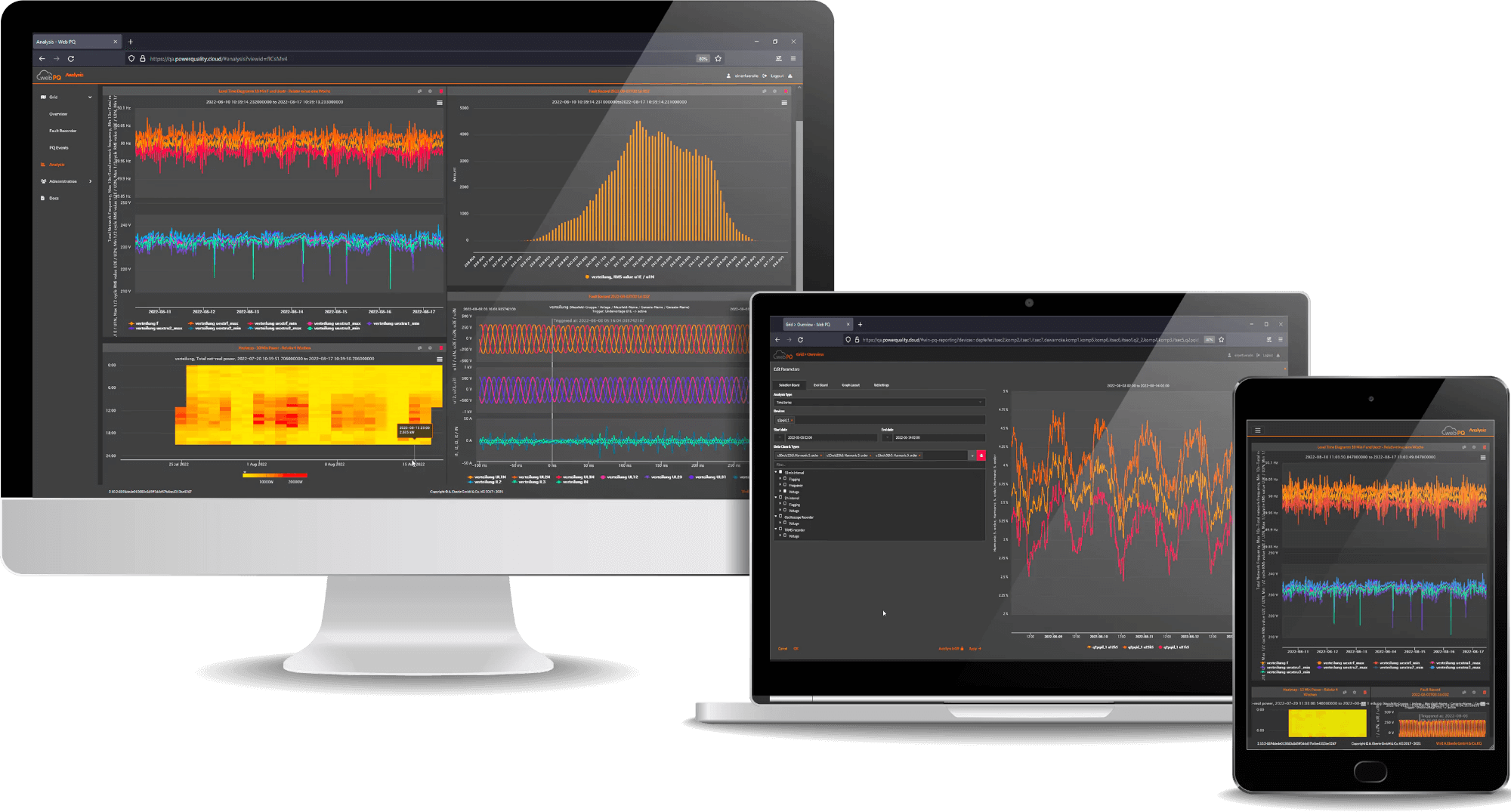
The new WebPQ® is the central analysis software for fixed fault recorders and power quality analysers, enabling seamless power quality monitoring and the evaluation of mobile power quality analysers* from A. Eberle.
In the context of VDE-AR-N 4110 & 4120 – particularly Annex F – WebPQ® provides a comprehensive solution for standards-compliant analysis and documentation of measurement data. Operators and certification bodies benefit from efficient evaluation for compliance monitoring, semi-annual inspections, and secure, uninterrupted data transfer.
Example of the Application of an ACA According to VDE-AR-N
The certification body involved in this project relies on automated data transfer in a standard Comtrade format for automated fault evaluation. Figure 5 shows that in the event of a mains failure, the data from the fault recorder is recorded in the measuring device using the VDE-AR-N 4110 template approved by the certifier. Subsequently, the data is automatically generated by the WebPQ® system software installed on site (SSH) and sent directly to the server of the certification body. In the event of a failure, the server directly evaluates the data and checks whether the power plant is operating in a grid-serving manner.
The customer also has the possibility to visualise and evaluate the measured power quality values at any time by means of a clear report. In case of communication difficulties due to an unbuffered network, the customer has the option of reading the data directly from the measuring device via an SD card and providing this data. In parallel, the high-precision measured values U, I, P, Q as well as the daily statistics of the PQ events are transmitted via a standard protocol – in this case IEC 61850 – to a SCADA system for on-site display and also for issuing alarms.

Conclusion
Through a uniform and coordinated procedure of all persons and companies involved, a high degree of cost savings and efficiency can be achieved for both the certifier and the operator of the power plants.
We will be happy to assist you during this process with our safe and certified class A (Ed. 3) measuring devices PQI-DE and PQI-DA smart in combination with the WebPQ® power quality system software as well as our experience in the field of services for the operation and installation of measuring devices.
Please contact us in good time before selecting the components – we will be happy to help you.


Author
Fabian Leppich, Product Manager Power Quality System


